The World Ahead 2027 · cover revealed 16 November
The Economist 2027 coversymbol by symbol
On 16 November The Economist showed the cover of The World Ahead 2027: a black, red and white disc packed with leaders, rockets, a broken pipeline, a circuit-board brain and a ballot box. I take it apart piece by piece and check which parts come with dates and which are only drawings.
Facts first, because every year this cover attracts more guesses than facts. The World Ahead 2027 was unveiled on 16 November 2026; the publisher's press release is dated 17 November. The issue ships with the weekly print edition dated 21 November and goes on sale as a stand-alone edition from 26 November. The artwork is by Cleon Peterson, as the magazine itself credits it in its post on X.
The editor is Tom Standage. In the release he announces the start of the post-Trump era and immediately adds that the president will not go quietly: after Republicans lost both chambers of Congress he will be less a lame duck than, in his words, a "destructive Angry Bird". The other themes are the aftershocks of the Iran war, record heat, a backlash against AI, the French election, bond markets, Taiwan, weight-loss drugs, cheap space launch and Hollywood.
The Economist does not publish a key to the drawing. It only says that the elements of the cover correspond to articles in the issue. So I match each group of symbols to one of the ten themes the publisher announced, add the hard dates and numbers for 2027, and finish with my own estimate of how likely it is. Where a symbol fits none of the themes, I say plainly that the reading is mine.
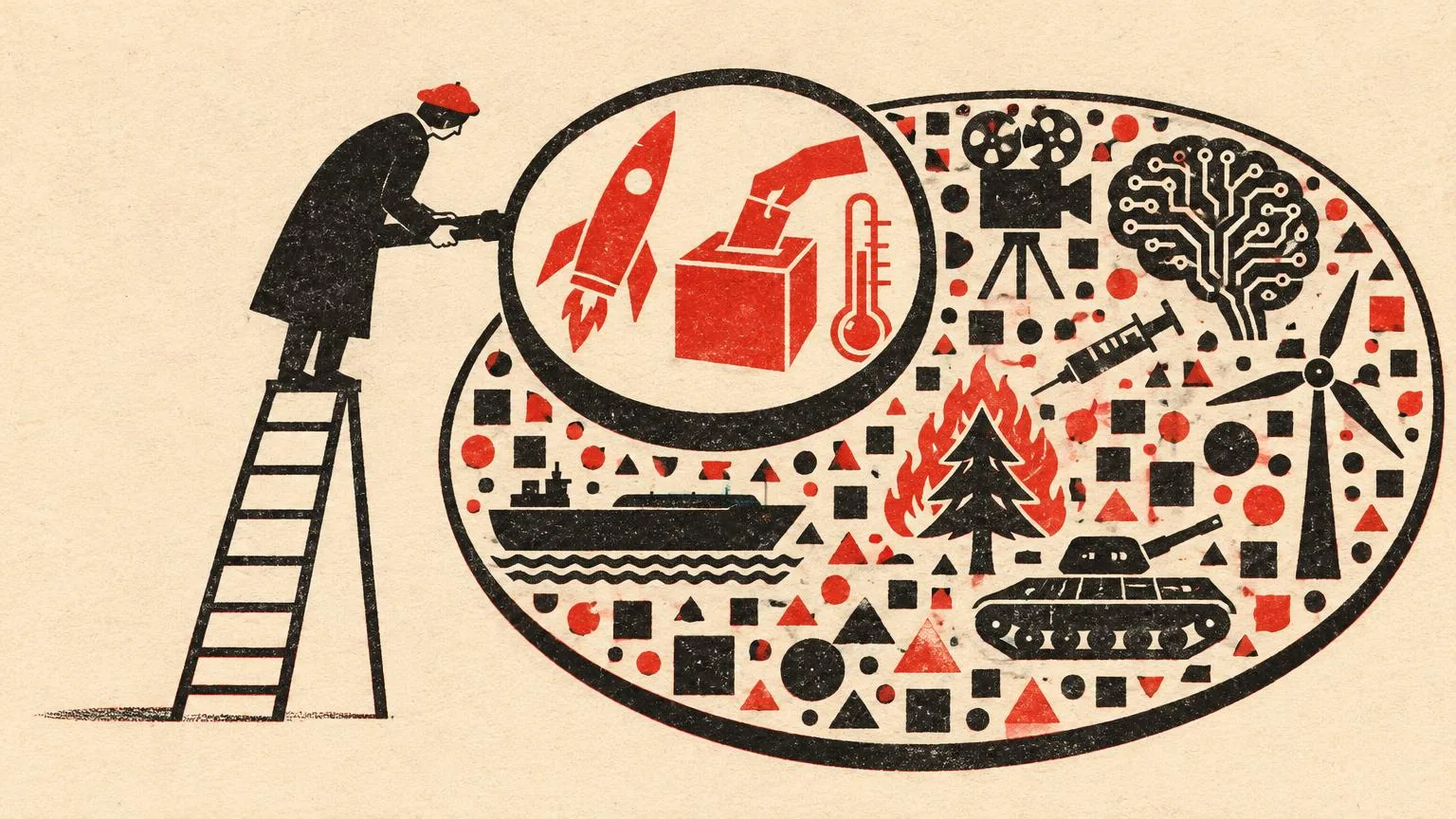
I am not showing a scan of the cover, because it is someone else's artwork. The original is in the magazine's official post below; the diagram in the scrolling section is my own, drawn from scratch, with the same groups in the same places.
themes for the yearlisted by the editor
cover linesprinted under the title
print editionstand-alone from 26.11
French first roundrun-off on 2 May 2027
What is on the cover
Three colours, one disc, six cover lines
The cover uses three colours: black, red and the white of the paper. Everything sits inside one disc. A row of figures in suits stands on top; below them the landscape breaks into scenes - a rocket launch, a columned building, a chart with an arrow pointing down, a burning forest, a crowd under a monument, tanks, a tanker on a red sea. At the very bottom are tents and huddled figures. Those who decide stand high. Those who bear the consequences sit at the bottom.
Six lines are printed under the title. They are the only text on the cover and the only hint from the editors about what the drawing shows:
- Trump's final chapternot going quietly
- Artificial intelligenceacceleration, risks and backlash
- After Iranregional and global reverberations
- Climate changehottest year ever, again
- Populism on the risewhat is mightier than Le Pen?
- Hollywood rebootsfranchise fatigue
The fifth line is a pun on the proverb that the pen is mightier than the sword. The answer comes on 18 April and 2 May 2027, in the two rounds of the French presidential election.
Six lines are shorthand. The full list has ten items, and that list is the key to the drawing.
The World Ahead 2027 cover in the editors' own post on X.
— The Economist (@TheEconomist) X, 17.11.2026
Symbol by symbol
14 groups, from the top of the disc to the tents at the bottom
Scroll. The diagram zooms in on the group you are reading about, and a number on the diagram takes you to its card. Each card has three parts: what you can see, what the editors say and what 2027 actually holds, and my own rating on a five-step scale from unlikely to certain.
01/ 14
A row of figures on top of the disc
Editors' theme 1: the post-Trump era
- What you see
- Six figures in suits stand on a platform between banners. One has a pale quiff, another is entirely red and holds a sheet of paper. Below them two red silhouettes shake hands. On the right of the disc stands a tower with a TRUMP sign, and next to it rides a red horseman in a hat.
- What it means for 2027
- This is the lead theme. The editors write that the race to succeed Donald Trump is beginning, while the president, having lost both chambers of Congress, becomes more aggressive and mercurial: more executive orders, legal spats, sudden renamings of geographical features, grandiose building projects and military adventures. The new Congress convenes on 3 January 2027 with Democratic majorities in both chambers. Trump stays in office until January 2029, so 2027 is the year candidates on both sides start positioning for the primaries. I read the tower as those building projects and the cowboy as an America that acts alone - that part is my reading.
My ratingcertainThat Trump will be at the centre of the year is certain from the calendar. That he will govern by executive order and fight Congress is very likely. The names of the successors are still guesswork.
02/ 14
A circuit-board brain, a robot and a rain of ones and zeros
Editors' theme 4: the AI backlash grows
- What you see
- In the very centre of the disc sits a black brain crossed by red traces like a printed circuit board. A humanoid robot runs beside it, ones and zeros fall around it, and there are chips and a server cabinet with its door open. Four men in dark jackets stand above.
- What it means for 2027
- The editors write about a backlash against AI and a rising danger of a crash, as AI firms take on more debt in complex, opaque deals. They add that worries about political, financial and cyber risks are justified, while those about jobs and the environment are overstated. The backdrop is fresh. On 18 November 2026 Anthropic priced the largest IPO on record: 83 dollars a share, about 81.3 billion dollars raised, a valuation of roughly 1.5 trillion. A week earlier the sector was shaken by a board investigation at Nvidia and the removal of Jensen Huang, and Reuters described a sell-off in AI stocks after midterms in which Democrats promised tougher rules for data centres.
My ratingvery likelyThe political backlash is already under way, so more of it is very likely. A crash is another matter: a correction is likely, the whole bubble bursting within one year is a coin toss.
03/ 14
A falling chart, a stack of banknotes and casino chips
Editors' theme 6: bond-market pressure
- What you see
- A red line breaks and ends in an arrow pointing down. Under it lies a stack of banknotes, next to three piles of gaming chips. Four identical men with briefcases walk out of a building with columns.
- What it means for 2027
- Theme six is bonds. The editors write that many rich countries are living beyond their means, yields are rising and this cannot go on forever: something, somewhere, has to break. On 18 November 2026 the American 30-year Treasury yielded 5.41 percent and the 10-year more than 5 percent, with markets pricing in a Federal Reserve rate rise in December. In France the 10-year yield rose above 4.95 percent on 1 October, the highest since July 2002, and the spread over German bonds reached 150 basis points. I read the chips as a comment on how data centres and public debt are financed today: as a bet.
My ratinglikelyHigh yields in 2027 are the starting point, not a forecast. A sudden crisis in one large country is likely but not settled. The weakest link is France in an election year.
04/ 14
A broken pipeline, a tanker in chains and a camel
Editors' theme 2: aftershocks from Iran
- What you see
- On the right of the disc a thick pipe snaps in two and oil drips from it. Below, a tanker sits on a red sea, wrapped in chains, with red fighter jets overhead. At the top, on a red patch with a crescent and palm trees, a rider sits on a camel. There is also a warship and an airliner.
- What it means for 2027
- The editors make a strong claim: after this war America's allies no longer trust it and its enemies no longer fear it. The consequences will reshape regional politics, reconfigure energy flows and threaten food security, because fertiliser is in short supply. The war began on 28 February 2026 with joint American and Israeli strikes on Iran. The Strait of Hormuz was closed and March brought the steepest monthly rise in oil prices on record, with Brent up more than 50 percent. A two-week truce was announced in early April. According to the WTO, fertiliser shipments through Hormuz stopped in February and stayed near zero into July. Fatih Birol, head of the International Energy Agency, writes in the issue that he sees no credible path back to the situation of February 2026.
My ratingcertainThe effects are already here, so this is description rather than forecast. Whether the strait returns to full capacity in 2027 is a coin toss.
05/ 14
A burning forest, a deer and a thermometer
Editors' theme 3: hottest year ever, again
- What you see
- On the left of the disc red flames engulf black spruces and a deer stands on a hill. At the bottom, next to a burning barrel, is a red thermometer.
- What it means for 2027
- The editors expect another year of droughts, wildfires and heat waves. Here there are numbers. The Copernicus service reported that October 2026 was the warmest October on record, 1.75 degrees C above pre-industrial levels, and that 2026 is virtually certain to exceed 1.5 degrees, most likely ending as the second-warmest year after 2024. The World Meteorological Organization warned on 3 September that El Nino would reach very strong intensity towards the end of 2026 and, with a likelihood of nearly 100 percent, persist through February 2027. The year after a strong El Nino peaks tends to be warmer than the year of the peak, as in 2016 and 2024.
My ratingvery likelyA new global temperature record in 2027 is very likely. It is the best-supported claim on the whole cover.
06/ 14
Wind turbines and a red pickup at a charger
Editors' theme 3, second half: Trump as a salesman for renewables
- What you see
- Two wind turbines stand on the lower right edge of the disc. Higher up, near the centre, an angular red pickup is plugged into a post marked with a lightning bolt.
- What it means for 2027
- This is the other half of the climate theme. The editors write, with some irony, that Trump has unwittingly become the world's greatest salesman for renewable energy. After the oil shock, home-made power from sun and wind is not only climate policy but an escape from the swings of global energy markets. The logic is simple: any country that imports oil and gas through Hormuz saw the bill in March 2026. The guest authors include He Xiaopeng, head of the Chinese electric-car maker Xpeng, and Bob Mumgaard of a company building a fusion reactor.
My ratingvery likelyMore investment in solar, wind and storage after the oil shock is very likely. Whether it changes emissions as early as 2027 is a coin toss.
07/ 14
The Republic monument, a cracked euro, a ballot box and a boot
Editors' theme 5: Europe's populist right
- What you see
- The densest scene on the cover. Parisian apartment blocks, a statue of a woman holding an olive branch - Marianne on the Place de la Republique - and a crowd under a flag with a cracked euro sign. Next to them a hand drops a ballot into a box, and a heavy boot hangs above it.
- What it means for 2027
- The editors write that victory for Marine Le Pen would throw a spanner into the Franco-German engine of the European Union and heighten concern about debt-laden France's public finances. The cracked euro says the same without words. The first round is on 18 April and the run-off on 2 May 2027. On 7 July 2026 the Paris appeals court upheld Le Pen's embezzlement conviction but cut her ban from office to 45 months, 30 of them suspended, which in practice clears the way for her to run. In an Ifop poll taken on 13-16 November she scores 32 to 36 percent in the first round, depending on the line-up, with Jean-Luc Melenchon second on 17 to 19.5 percent, and she wins the run-off clearly in all six scenarios tested.
My ratinglikelyFive months out, a Le Pen victory is likely, meaning more probable than not. French run-offs have overturned polls before, so it is far from very likely.
08/ 14
A Chinese flag, a camera, missiles and a blast over a city
Editors' theme 7: Taiwan's moment of peril
- What you see
- On the left of the disc a Chinese flag flies over a crowd, with a surveillance camera on a pole beside it. Lower down, four missiles fly diagonally and a red explosion tears through a city skyline. Drones hover in a row above the shoreline.
- What it means for 2027
- The editors recall that Xi Jinping is said to have set 2027 as the deadline for China's armed forces to be ready to take the island. They add a second thought at once: technology has changed warfare and made it easier for smaller powers to fend off larger ones, as Ukraine and Iran showed. 2027 is the centenary of the People's Liberation Army, on 1 August. The readiness date was made public in 2023 by the then CIA director William Burns, who stressed that readiness is not a decision. The latest American intelligence assessment, from March 2026, goes further: Chinese leaders do not currently plan to invade Taiwan in 2027 and have no fixed timeline for unification.
My ratingunlikelyAn invasion in 2027 is unlikely. Military pressure around the island - drills, rehearsed blockades, incursions - is very likely. The drawing shows the scenario the issue debates, not the one the editors are betting on.
09/ 14
A syringe, capsules, a lab worker and a lipstick
Editors' theme 8: the Ozempic effect
- What you see
- Right next to the brain stands a red syringe with capsules lying beside it. Below, a lab worker holds something up to the light, and a shelf carries small bottles, a lipstick and boxes of cosmetics.
- What it means for 2027
- Theme eight is about money rather than medicine. The editors write that slimming drugs are changing consumer behaviour: the newly slender splurge on clothes, cosmetics and fitness. Hence the lipstick. The second strand is longevity: the drugs' anti-ageing effects are reviving pharmaceutical companies' interest in treatments that extend life. In 2026 pills from this class of drugs reached the market, cheaper and more convenient than injections, which widens the pool of patients faster than expected a year ago, when the same subject was on the 2026 cover.
My ratingvery likelyThe shift in spending is already being measured in consumer surveys, so more of it is very likely. Proof that these drugs extend life arriving in 2027 is unlikely; such trials take years.
10/ 14
A rocket, a satellite and an astronaut
Editors' theme 9: cheaper space launch
- What you see
- In the upper left of the disc, on a black sky with stars, hang a red satellite with solar panels and an astronaut on a tether. One rocket is in flight, another lifts off from clouds of red smoke.
- What it means for 2027
- The editors promise three things: SpaceX's Starship will start making regular satellite launches, the first private-sector space station will launch, and the idea of building data centres in orbit will start to sound less crazy. Starship carried next-generation Starlink satellites on its thirteenth flight on 24 July 2026. The private station is Vast's Haven-1, whose launch slipped in January 2026 to no earlier than the first quarter of 2027.
My ratinglikelyRegular Starship flights with payloads are very likely. A Haven-1 launch in 2027 is likely, although dates in this industry slip more often than they hold. A data centre in orbit in 2027 is unlikely beyond a demonstrator.
11/ 14
A film projector and a telescope
Editors' theme 10: rebooting Hollywood
- What you see
- At the bottom of the disc stands an old projector with two red reels. Beside it a figure looks through a telescope at a starry sky.
- What it means for 2027
- Big franchises are trying to reach new audiences while low-budget films made by YouTubers earn real money in cinemas. The editors ask whether audiences want something new, and answer half-jokingly that Star Wars may be more relevant than ever in 2027: it features a military superpower humbled by small, cheap craft, and droids with agendas of their own. The dates are fixed. On 19 February 2027 the original Star Wars returns to cinemas for its 50th anniversary, and on 28 May the new film Star Wars: Starfighter opens. The example from the other side is Iron Lung by the YouTuber Markiplier: a budget of 3 million dollars and 51.2 million dollars at the worldwide box office. I link the telescope to the magazine's own opening line about this issue: modern life can feel like science fiction, and all that is missing is the aliens.
My ratingcertainThe releases have dates, so that part is certain. Whether audiences are tired of franchises will show in the May box office. I am not betting on that one.
12/ 14
Tents, a woman with children and a herder with cattle
Editors' themes 2 and 3: food security at risk
- What you see
- The lower edge of the disc is the quietest. There are red tents, a woman crouching with two children, someone sitting with head on knees, and sacks. Higher up a herder leads two cows.
- What it means for 2027
- This is not among the cover lines, but it is in the release. Standage writes that fertiliser shortages after the Iran war and a super El Nino threaten food security for millions. The mechanism can be counted. According to the WTO, Gulf economies supplied 24.8 percent of global nitrogen fertiliser exports, and the price of urea jumped from about 400 dollars a tonne to more than 850 in April 2026 before falling back to 453 in June. India sourced almost two thirds of its imported nitrogen fertiliser from the Gulf. A strong El Nino usually means drought in parts of Asia, Africa and Australia. Both factors hit the same harvests.
My ratinglikelyHigher food prices in countries that depend on imported fertiliser are likely. The scale will show in the harvests of the first half of 2027.
13/ 14
A Kremlin tower, an hourglass and two tanks
Outside the top ten - my reading
- What you see
- On the right stands a red tower with a clock and a star on top: the Spasskaya Tower of the Moscow Kremlin. Beside it is an hourglass with the sand nearly run through. Lower down, in the middle of the disc, two tanks fire at each other barrel to barrel.
- What it means for 2027
- Russia and Ukraine are neither on the list of ten themes nor among the cover lines. The drawing is unambiguous all the same: the war goes on and time is running out. I read two identical tanks facing each other as a stalemate. In November 2026 there is no ceasefire. Talks between America, Ukraine and Russia took place in Abu Dhabi after a nine-month pause and ended with a prisoner exchange. The Kremlin repeats that it wants a lasting peace rather than a temporary truce and that negotiations may take a long time.
My ratinga coin tossA lasting peace in 2027 is a coin toss. The fact that the editors left this war out of the top ten suggests they expect no breakthrough.
14/ 14
A crystal ball and its audience
The editors' self-mockery - my reading
- What you see
- At the bottom, between the projector and the thermometer, stands a crystal ball with sparkles, and in front of it a row of dark heads. One figure stands aside holding a red map.
- What it means for 2027
- This is a portrait of the annual itself: an audience staring at a fortune-teller's prop. The editors enjoy the joke. In a piece marking the series' 40th year they admitted that however often they are wrong, some people believe they secretly know everything, and that they sometimes add misleading symbols for those hunting for a code. A few elements fit that category, or I simply cannot place them: signs resembling Greek letters next to the chips, an arch like India Gate in Delhi, a red pagoda with a yen sign and a snow-capped peak (Japan's prime minister, Takaichi Sanae, is among the guest authors), a red mountain under a night sky and a broadcasting mast.
My ratingcertainOne thing is certain: some symbols mean no more than what you see. I set aside any reading that needs three steps of association.
The editors' ten themes
From the publisher's release of 17 November
| Theme | What the editors say | How we will know |
|---|---|---|
| 01The post-Trump era | The succession race begins. A president without a majority in Congress turns more aggressive. | 3 January 2027: the new Congress convenes |
| 02Aftershocks from Iran | Allies no longer trust America, enemies no longer fear it. New energy routes, scarce fertiliser. | traffic through the Strait of Hormuz, urea prices |
| 03Hottest year ever, again | Droughts, wildfires, heat waves. Trump as an accidental salesman for renewables. | January 2028: the temperature record for 2027 |
| 04The AI backlash grows | More debt in opaque deals, more danger of a crash. Job and environmental fears overstated. | AI share prices, new rules on data centres |
| 05Europe's populist right | A Le Pen victory would stall the Franco-German engine of the EU. | 18 April and 2 May 2027: French election |
| 06Bond-market pressure | Rich countries live beyond their means and yields are rising. Something has to break. | 10- and 30-year yields in America, France and Japan |
| 07Taiwan's moment of peril | The year of the reported readiness deadline for China's army. Cheap technology helps the weaker side. | 1 August 2027: centenary of the PLA |
| 08The Ozempic effect | The newly slender spend on clothes, cosmetics and fitness. Longevity research revives. | retail sales figures, clinical trials |
| 09Cheaper space launch | Regular Starship launches, the first private space station, data centres in orbit. | Q1 2027: launch of Haven-1 |
| 10Rebooting Hollywood | Franchises look for new audiences while cheap YouTuber films make money. | 19 February and 28 May 2027: two Star Wars releases |
The 2027 calendar
Dates you can already put in the diary
- 3 JanuaryThe new US Congress convenes with Democratic majorities in both chambers.see the symbol
- Q1Earliest launch window for the private space station Haven-1.see the symbol
- to FebruaryAccording to the WMO, El Nino will almost certainly persist until then.see the symbol
- 19 FebruaryThe original 1977 Star Wars returns to cinemas for its 50th anniversary.see the symbol
- 18 AprilFirst round of the French presidential election.see the symbol
- 2 MayRun-off of the French presidential election.see the symbol
- 28 MayRelease of Star Wars: Starfighter.see the symbol
- 1 AugustCentenary of China's People's Liberation Army.see the symbol
Fake covers and conspiracy theories
Two forgeries and one doctored original
Two forgeries were circulating before the real cover came out. The first, with a cake bearing the number 2027, was checked by the Australian agency AAP on 10 September: a spokesperson for The Economist confirmed it was fake, and a verification tool found an AI generator's watermark in the image. The second, an apocalyptic design with angels and a line about the Rapture, was described by the Brazilian fact-checker Aos Fatos on 17 November. Neither has anything in common with the real artwork.
After the launch came a second wave: graphics in which someone added month names and red dividing lines to the real cover and announced that it predicts 24 specific events. The Austrian fact-checker Mimikama reviewed the claim and was clear: the cover is real, the schedule was added. Aos Fatos lists three more theories from the first day - a military intervention in Brazil, the impeachment of Donald Trump and a global financial reset. None of them is in the issue.
How to read this cover
Four rules that save time
Start with the text, not the drawing.
The six cover lines and the ten themes in the publisher's release explain most of the symbols. The rocket is the space theme, the syringe is the drugs theme. The drawing is a table of contents, not a cipher.
Symbols are literal.
A flag is a country, a ballot box is an election, a thermometer is temperature. If a reading needs three steps of association, it is usually a stretch.
The drawing shows a theme, not an outcome.
Missiles over a city do not mean the editors forecast an invasion of Taiwan. They mean the issue discusses one - and, as the text shows, rather doubts it.
Check where the image comes from.
The real cover is on economist.com and on the magazine's official accounts. It has three colours, the title The World Ahead 2027 and no dates or month names. A screenshot with a calendar drawn on it is not a source.
Frequently asked questions
The Economist 2027 cover in six answers
What does The Economist's 2027 cover show?
A black, red and white disc by Cleon Peterson that gathers illustrations for the themes of The World Ahead 2027: leaders on top, a circuit-board brain, a falling chart, a broken pipeline, a burning forest, the Republic monument in Paris with a ballot box, missiles beside a Chinese flag, a syringe, a rocket and a film projector.
When was The World Ahead 2027 cover released?
The magazine showed it on 16 November 2026 and the publisher's release is dated 17 November. The issue is part of the print edition dated 21 November and goes on sale separately from 26 November 2026.
Who drew The Economist's 2027 cover?
Cleon Peterson, an American artist known for black and red compositions. The magazine credits him in its post on X of 17 November 2026.
Does the cover predict a war over Taiwan in 2027?
No. The missiles and the explosion illustrate a theme the issue debates. The editors write about a reported readiness deadline for China's army, and the American intelligence assessment of March 2026 says China does not currently plan an invasion in 2027.
Does The Economist's cover predict the future?
No. It illustrates the themes the editors write about. Some come with fixed dates, some do not come true: the annual for 2020 did not foresee the pandemic and the one for 2022 did not have the war in Ukraine among its main themes.
Is the 2027 cover with month names and 24 predictions real?
The drawing is real, the calendar is not. The month names and red lines were added by someone else, as the fact-checker Mimikama established. The original has no dates at all.
Sources
As of 19 November 2026
- Economist Group: press release on The World Ahead 2027 (17 Nov 2026)
- The Economist on X: the cover with illustrator credit (17 Nov 2026)
- Economist Group: press release on The World Ahead 2026 (11 Nov 2025)
- Aos Fatos: new cover and a wave of conspiracy theories (17 Nov 2026)
- AAP FactCheck: fake Economist cover for 2027 (10 Sep 2026)
- Mimikama: the 24 alleged predictions on the 2027 cover
- Copernicus: warmest October on record, 2026 above 1.5 C (6 Nov 2026)
- WMO: El Nino set to become very strong (3 Sep 2026)
- WTO: fertiliser trade and the Strait of Hormuz conflict (10 Jul 2026)
- CSIS: how the war with Iran threatens food security (11 Mar 2026)
- Enerdata: two-week US-Iran truce (9 Apr 2026)
- Service-Public.fr: dates of the 2027 presidential election
- Reuters via Cyprus Mail: Ifop poll of 13-16 Nov 2026
- Eunews: appeal ruling in the Marine Le Pen case (7 Jul 2026)
- Al Jazeera: US intelligence on Taiwan and 2027 (19 Mar 2026)
- Al Jazeera: Ukraine peace talks (17 Nov 2026)
- CNBC: US Treasury yields (18 Nov 2026)
- Trading Economics: French yields at 2002 high (1 Oct 2026)
- CNBC: Anthropic IPO pricing (18 Nov 2026)
- Reuters via Investing.com: AI stocks sell-off (12 Nov 2026)
- Space.com: Starship flight 13 (24 Jul 2026)
- Payload: Vast delays Haven-1 to 2027 (20 Jan 2026)
- Inverse: Star Wars returns to cinemas on 19 Feb 2027
- The Numbers: Iron Lung box office
- KFF: Medicare's temporary GLP-1 programme
Opening illustration and cover diagram: promptowy.com. The diagram is not a reproduction of the cover; it shows where the groups of symbols sit. Original: The Economist, illustration by Cleon Peterson. Headlines set in Archivo (SIL Open Font License).