Perseid Meteor Shower 2027: U.S. Peak Times and Moonlight
The Perseids peak early on August 13, 2027. Find the forecast window in U.S. time zones, see how moonlight affects viewing, and learn what ZHR 110+ means.

Contents 6
The best night to put on your calendar for the 2027 Perseids is August 12 into August 13. The International Meteor Organization (IMO) puts the expected peak at 08:00-10:00 UT on August 13. In the contiguous United States, that's 4-6 a.m. Eastern, 3-5 a.m. Central, 2-4 a.m. Mountain and 1-3 a.m. Pacific daylight time. How much of that window is dark depends on where you are. The shower is active from July 17 through August 24, so a clear night either side is worth considering.
- The Perseids peak early on August 13, 2027. Find the forecast window in U.S. time zones, see how moonlight affects viewing, and learn what ZHR 110+ means.
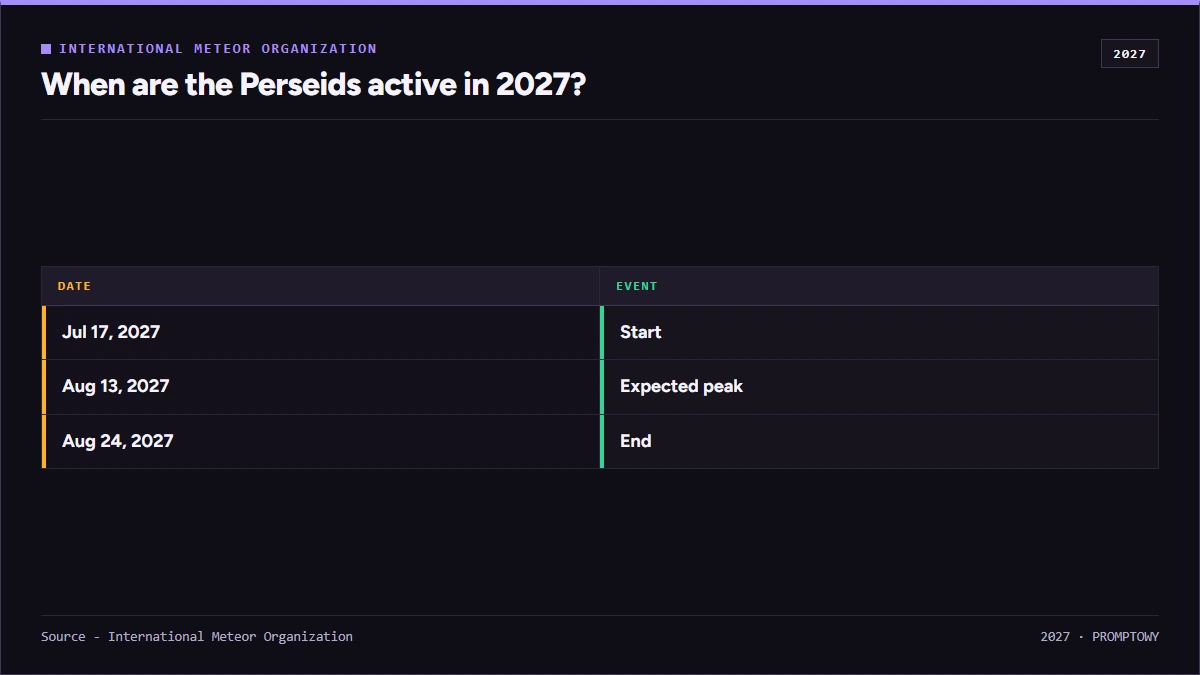
- Jul 17, 2027 - Start. Aug 13, 2027 - Expected peak. Aug 24, 2027 - End.
What will the Moon look like during the peak?
Expect a waxing gibbous Moon. I checked Griffith Observatory's Pacific time calendar. It puts first quarter at 9:54 p.m. PDT on August 8 and full Moon at 12:29 a.m. PDT on August 17. That puts the peak night between first quarter and full. Moonlight can wash out fainter streaks, so the Moon's local setting time matters as much as its phase when you're deciding when to head out.
Example for Southern California. If you're planning a drive from Los Angeles, check moonset and the start of morning twilight for your actual observing spot. Look for time after moonset that overlaps the 1-3 a.m. PDT peak window. If the overlap is short, you can keep watching after 3 a.m. while the sky is still dark. The shower's activity extends beyond the forecast peak window.
Why does the shower peak on August 13?
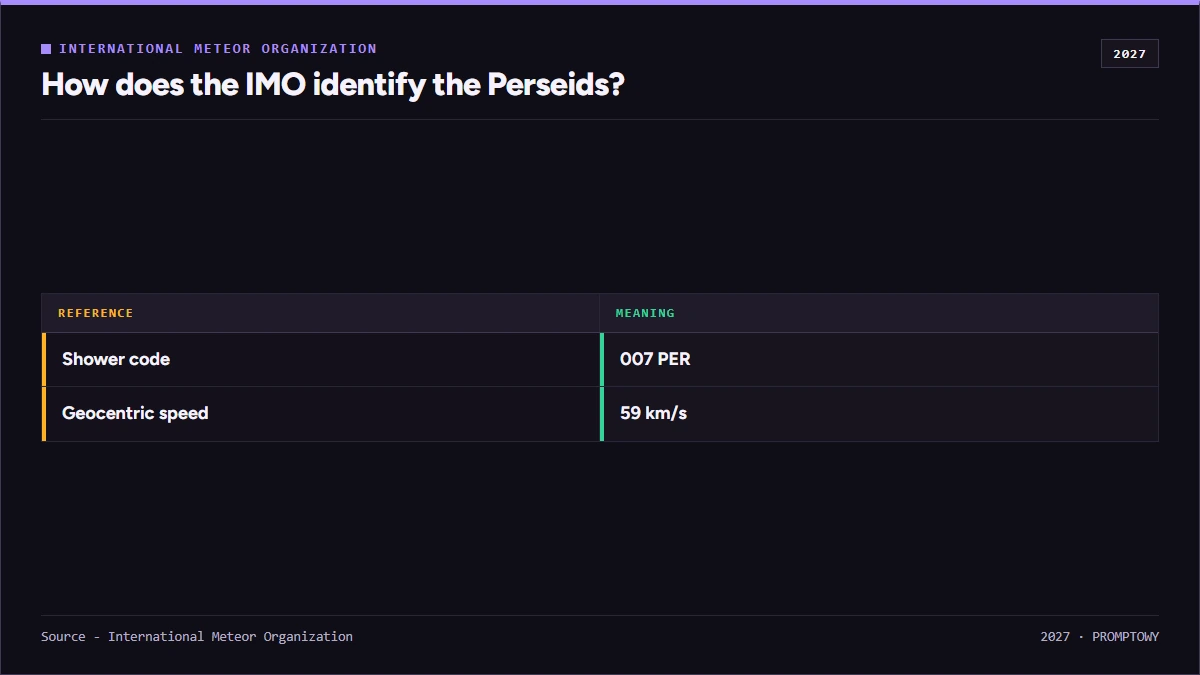
Earth crosses a stream of debris left by comet 109P/Swift-Tuttle each summer. The date comes from when Earth reaches the part of its orbit associated with the shower's usual peak. The IMO lists August 13 in the row marked 007 PER. Individual grains enter the atmosphere at about 59 kilometers per second, producing the quick streaks we see from the ground. The same stream gives us the annual shower, with plenty of time to spot meteors either side of its busiest hours.
How many meteors can you actually see?
The forecast ZHR of 110+ is a zenithal hourly rate. It describes what the rate would be under standardized conditions, with a dark, clear sky and the radiant directly overhead. Your count depends on how high the radiant is, how much sky you can see and how bright the sky is. Moonlight and city lights can hide faint meteors even when the shower is at its busiest. A count made from a suburban yard can therefore differ substantially from one made at a dark site during the same hour.
Where should you look?
The radiant is in Perseus. Think of it as the point you'll reach if you trace Perseid streaks backward across the sky. To see the streaks themselves, give your eyes a broad, unobstructed view, ideally away from the Moon and nearby lights. A lawn chair or blanket lets you scan more of the sky comfortably with the naked eye. Pick a backup night if clouds are forecast for August 12-13, and use local twilight and moonset times to plan that outing too.
Sources
- 2027 Phases of the Moon - Griffith Observatory - Southern California’s gateway to the cosmos!
- www.imo.net
- Prepare for Perseids! - NASA Science
Frequently asked questions
When are the Perseids active in 2027?
Jul 17, 2027 - Start. Aug 13, 2027 - Expected peak. Aug 24, 2027 - End.
How does the IMO identify the Perseids?
Shower code - 007 PER. Geocentric speed - 59 km/s.