Oxford Word of the Year 2026: When It’s Announced and What the Finalists Mean
Oxford announces its 2026 Word of the Year on December 1. Here’s what slopaganda, doomerism, microdrama, and post-literate mean in context.
Contents 10
- What makes something slopaganda?
- When does pessimism become doomerism?
- Why a microdrama is more than a short scene
- What does post-literate describe?
- Why did Cambridge choose human and Collins choose mogging?
- Which dictionary has announced its 2026 word?
- Which words are on Poland’s youth ballot?
- Questions about the Oxford vote
- Sources
- Frequently asked questions
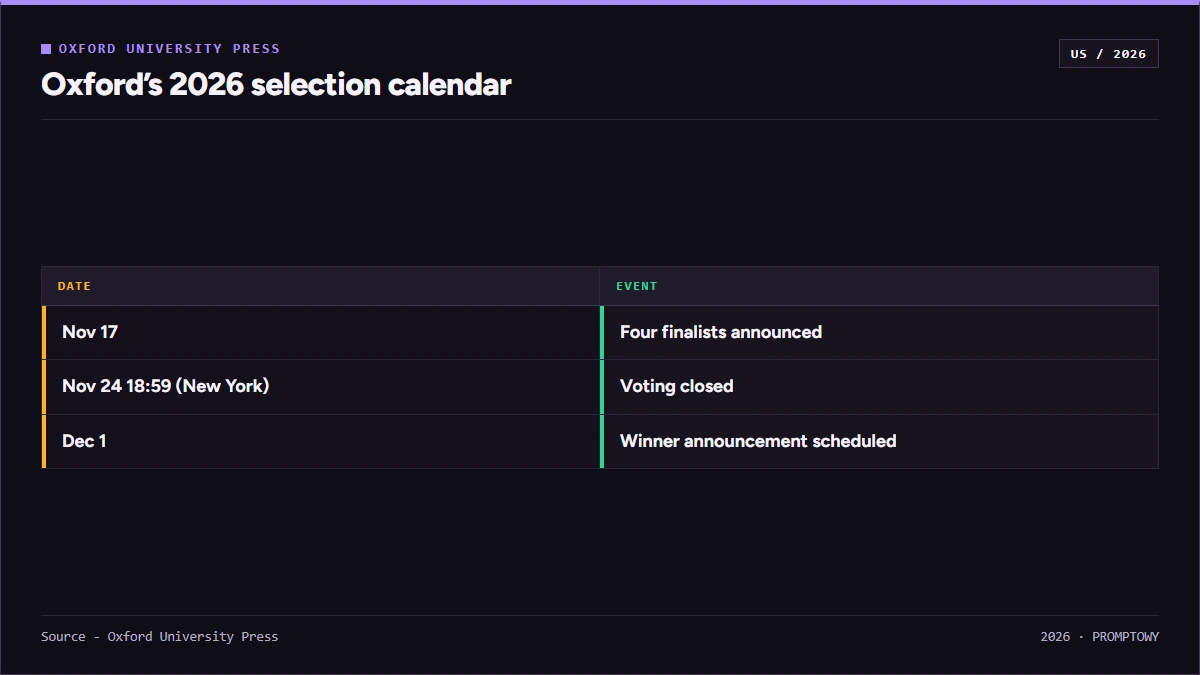
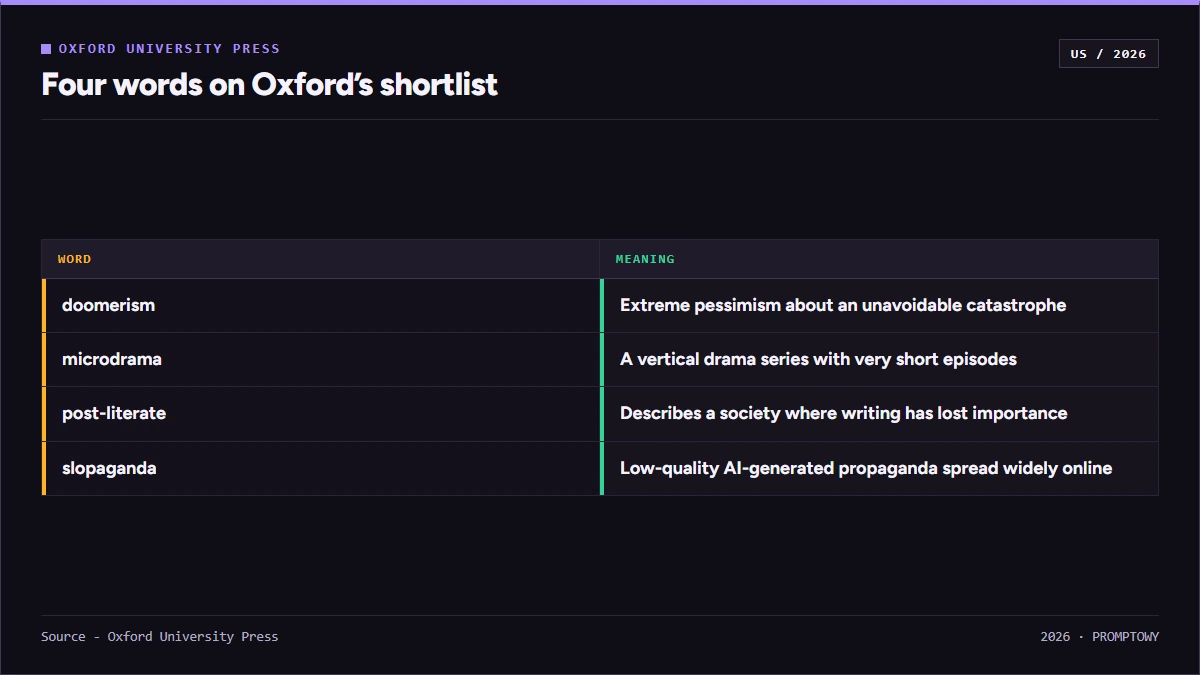
Oxford University Press will announce its 2026 Word of the Year on December 1. Its four finalists are doomerism, microdrama, post-literate, and slopaganda. Oxford released the shortlist on November 17 and closed public voting on November 24. Its language experts weigh the vote alongside public discussion and evidence from a corpus of 32 billion words.
- Oxford will announce its winning word on December 1, 2026.
- Cambridge chose human, while Collins selected mogging.
What makes something slopaganda?
Slopaganda is low-quality propaganda made with generative AI and circulated widely online. The second half of the word tells you what the material is meant to do. Think of a feed flooded with crude, misleading posts designed to push a position. The term covers how the material was made, why it was made, and how widely it was pushed.
There’s a familiar root for US readers. In its January 2026 announcement, the American Dialect Society said it chose slop as its word for 2025 and noted that the word could already suggest AI-generated junk on its own. In Oxford’s finalist, propaganda narrows that meaning to content aimed at shaping opinion.
Example: “The neighborhood group called the flood of AI-generated posts slopaganda after they circulated bogus endorsements ahead of a school board election.”
When does pessimism become doomerism?
Doomerism is extreme pessimism built around the conviction that a catastrophe is inevitable and beyond anyone’s ability to prevent. The word fits a claim about climate change or AI when the speaker treats the outcome as settled. In reading Oxford’s definition, I’d pay particular attention to what the speaker thinks can still be done. For a doomer, even a serious effort would be futile.
Example: “Doomerism took over the discussion when a panelist said there was no point preparing for future heat waves because the city was already doomed.”
Why a microdrama is more than a short scene
A microdrama is a scripted drama series with very short episodes presented vertically for smartphone viewing. The label describes the shape of the series. The frame is built for a phone held upright, and the story moves forward in quick installments. A scene can last just a few seconds in any kind of show. To identify a microdrama, look at how the whole story is made to be watched.
Example: “In a microdrama set at a county fair, each vertical episode follows the pie contest judge as she discovers another clue about a missing recipe.”
What does post-literate describe?
Post-literate describes a society or period in which reading, writing, and the written word have lost much of their importance. The adjective is about the place of writing in everyday life. It can describe a setting where people retain the ability to read but increasingly use audio or video to get information, learn a process, or follow public affairs.
Example: “The novel imagines a post-literate town where residents get everything from city council notices to lease terms as spoken recordings.”
Why did Cambridge choose human and Collins choose mogging?
Picture a recording labeled “human voice.” Cambridge’s choice, human, gets at why that label now carries information: it tells a listener who, or what, did the speaking. The dictionary pointed to renewed attention to human creativity and authenticity as AI tools spread. Collins picked mogging two weeks earlier. Someone who walks into a room and outshines everyone else through looks, confidence or status can be described as mogging them.
Which dictionary has announced its 2026 word?
When I see a word-of-the-year headline, I look for the name of the organization and the edition. In the US, the American Dialect Society and Merriam-Webster both picked slop for 2025. As of November 26, Merriam-Webster’s annual page still featured that 2025 choice. I found no 2026 announcement date there.
| Organization | Result or next date |
|---|---|
| Collins | November 3, 2026: mogging. |
| Cambridge Dictionary | November 17, 2026: human. |
| Oxford University Press | December 1, 2026: the winning word is due. |
| PWN in Poland | The public vote runs through November 30. The result is due in December. |
| Merriam-Webster | Slop is the 2025 pick on the annual page. |
Which words are on Poland’s youth ballot?
PWN’s Youth Word of the Year follows its own timetable. Oxford had already closed its vote at 6:59 p.m. Eastern on November 24, when it was 12:59 a.m. the next day in Poland. The Polish poll was still open. Its jury put twelve entries on the ballot. Two entries include more than one form:
- aura / aura farming
- bro
- brokuł
- kukiriniarz
- larp / larpować
- son
- peak
- płakał
- slop
- spływka
- tuff
- unc
Polish voters choose a word from that list. A separate jury award recognizes a word submitted with a definition. English speakers may recognize bro or unc, a shortened form of uncle. Here those terms are entries in a poll about young people’s use of Polish.
Questions about the Oxford vote
When does Oxford announce its 2026 Word of the Year?
Oxford University Press has scheduled the result for December 1, after its experts review the votes, the language data and the public discussion.
Did human win the Oxford vote?
Cambridge Dictionary selected human. Oxford has a separate shortlist of four terms.
What does Collins mean by mogging?
It describes outshining someone, for example through looks, confidence or status.
Sources
- americandialect.org
- Shortlist unveiled for Oxford Word of the Year 2026 - Oxford University Press
- Oxford Word of the Year 2026 - Oxford University Press
- Cambridge Dictionary on human
- University of Cambridge news archive, November 17
- Collins Dictionary on mogging
- Merriam-Webster’s annual selection
- Polish Tourism Organisation, the PWN poll schedule
- City of Wrocław, the Polish finalists and their meanings
Frequently asked questions
When does Oxford announce its 2026 Word of the Year?
Oxford University Press has scheduled the result for December 1, after its experts review the votes, the language data and the public discussion.
Did human win the Oxford vote?
Cambridge Dictionary selected human. Oxford has a separate shortlist of four terms.
What does Collins mean by mogging?
It describes outshining someone, for example through looks, confidence or status.