Oracle’s Credit Spread Hits a Record 356 bps Despite $300B OpenAI Deal
Oracle's five-year CDS hit a record 356 basis points, up from under 80 a year ago, despite a $300 billion OpenAI contract. Bondholders see risk.

Contents 7
Insuring Oracle's five-year debt against default now costs 356 basis points. That is a record, and a year ago it was below 80. Oracle's credit premium has therefore more than quadrupled, even though the company has signed a five-year, $300 billion contract with OpenAI.
- Oracle's five-year CDS costs a record 356 basis points, versus under 80 a year earlier.
- The company's long-dated bonds yield about 9%, and the spread over US Treasuries has topped 3.5 percentage points.
- S&P estimates OpenAI accounted for about half of Oracle's order backlog, and free cash flow in fiscal 2026 was minus $23.7 billion.
- Oracle expects positive free cash flow only in the second half of fiscal 2028.
Bondholders do not see a guarantee in that deal. They see more of a source of risk, because a large share of Oracle's order backlog depends on a single customer.
On November 20, the company announced that the contract's financing is fully secured. Even so, according to Bloomberg, its long-dated bonds yield about 9%.
What does Oracle's credit premium measure, and how should you read it?
A CDS (credit default swap) works like a policy on someone else's debt. The buyer pays a premium every year, and the seller covers the loss if the issuer stops repaying its bonds. The record level of 356 basis points comes from S&P Global Market Intelligence data cited by ad-hoc-news.de.
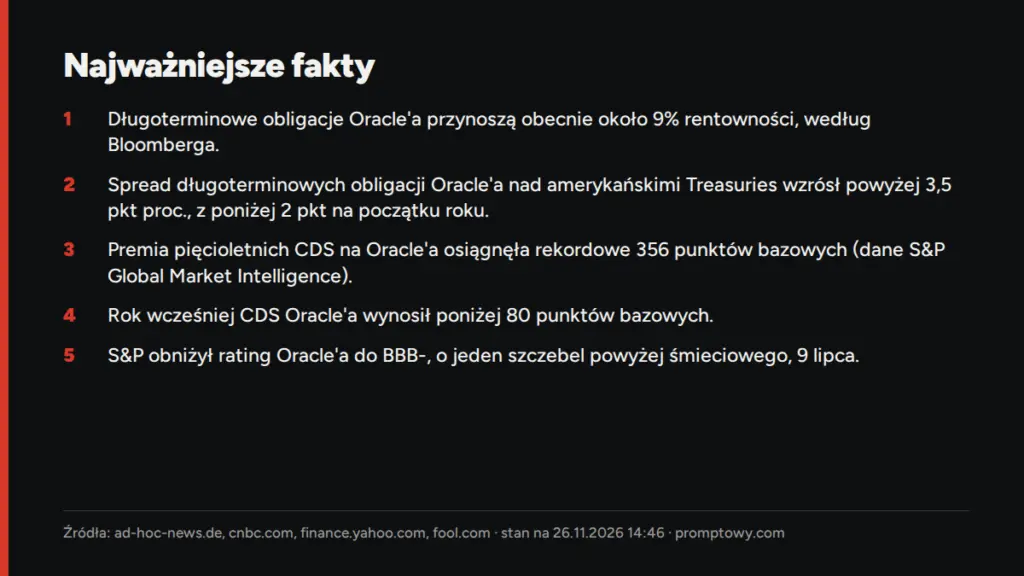
The second indicator is the spread, meaning the difference between the yield on the company's bonds and the yield on US Treasuries of a similar maturity. It is the extra return an investor demands for lending to the company rather than to the government. For Oracle's long-dated bonds it has exceeded 3.5 percentage points, whereas at the start of the year it was below 2 percentage points.
Neither of these indicators is a forecast of bankruptcy. Yield tells you what return an investor gets at the current bond price, and the CDS tells you what protection costs. Oracle is also not the only one: Alphabet, SpaceX and CoreWeave have also recorded CDS highs.
Why doesn't the OpenAI contract reassure creditors?
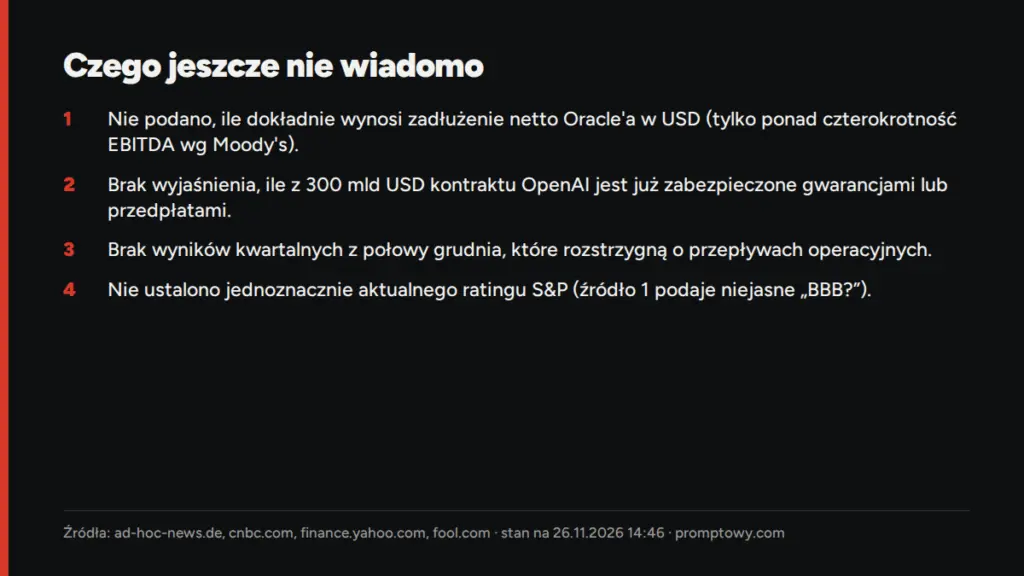
The computing capacity agreement for OpenAI is due to start in 2027. On top of that comes concentration: S&P estimates that OpenAI accounted for about half of the then-reported order backlog of $638 billion, as reported by Yahoo Finance.
Newer data, for the first quarter of fiscal 2027, put the backlog at $664 billion. The difference comes from the dates, not from a dispute between sources.
The same agency warns that if OpenAI did not pay as planned, Oracle would be left with data center leases that are hard to terminate. It is the position of a developer who has leased an entire office tower to a single tenant for years. As long as the tenant pays, the business is excellent, but once it stops, the rent still has to be paid.
The tenant has already given cause for concern. OpenAI told investors that at the end of September it reached about $50 billion in annualized revenue, less than the $68 billion widely reported earlier. After that news, shares of AI-related companies, including Oracle, fell, as described by CNBC.
Analysts also point to circular financing. This is an arrangement in which chip makers, cloud providers and model developers finance one another's expansion, so trouble at one link quickly spreads to the others.
What exactly did Oracle promise on November 20?
The company declared that the OpenAI contract is fully financed. It added that in fiscal years 2027-2030 it will raise no more than $20 billion from the market: half from equity, half from gross debt, not counting the refinancing of old obligations. The details are reported by Yahoo Finance.
Earlier, in the first quarter of fiscal 2027, Oracle completed a $20 billion share sale. In November came another issuance: 86,206,897 shares at $116 and $10 billion of bonds in five tranches maturing between 2029 and 2046.
The coupons on these bonds range from 7.000% to 8.650%. According to Securities.io, the proceeds are to go toward general corporate purposes, not solely the OpenAI contract.
ad-hoc-news.de draws attention to one distinction:
"This statement applies to the project - it does not mean positive free cash flow at the group level." - ad-hoc-news.de
A financed project and a company that earns more cash than it spends are two different things. A lender lends to the whole company, not to a single project.
How much cash are Oracle's data centers consuming?
Free cash flow is the cash left after paying for day-to-day operations and investment. In fiscal 2026 it came to minus $23.7 billion at Oracle, because the company spent $56 billion on fixed assets. The first quarter of fiscal 2027 added another minus $5 billion.
Spending is not slowing down. For the fiscal year ending in May 2027, Oracle plans capital expenditure of $90-95 billion. JPMorgan estimates that through fiscal 2028 about $220 billion in total is needed, roughly half of which is to be covered by customer prepayments and supplier financing. This is cited by ad-hoc-news.de.
The other half has to be covered from the market or from the company's own operations. It was not possible to establish exactly how much Oracle's net debt is in dollars. The available sources say only that, according to Moody's, it exceeds four times EBITDA, that is, operating profit before depreciation and amortization.
Oracle has its arguments. Cloud infrastructure revenue rose 120% in the first quarter of fiscal 2027, to $7.4 billion. The company forecasts positive free cash flow in the second half of fiscal 2028 and more than $30 billion in fiscal 2029.
The analyst consensus, however, assumes only $17.5 billion for fiscal 2029. That gap between management's promise and market expectations explains the credit premium better than any single indicator.
How do rating agencies and investors see it?
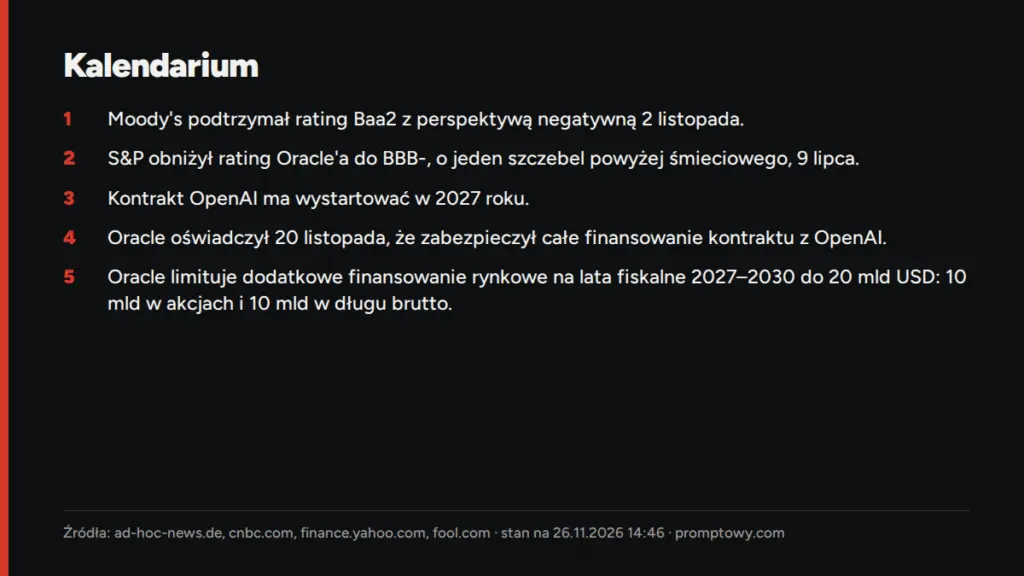
| Date | What happened | Source |
|---|---|---|
July 9 | S&P cuts Oracle's rating to BBB-, one notch above junk | |
End of September | OpenAI reaches about $50 billion in annualized revenue, below the $68 billion reported earlier | |
November 2 | Moody's affirms the Baa2 rating with a negative outlook | |
November 20 | Oracle states that the OpenAI contract is fully financed |
It was not possible to confirm unambiguously whether S&P's July rating is still in force, because one of the sources states it unclearly. If it has not changed, Oracle is one notch away from junk status. A drop into that category closes the door for some funds whose charters forbid holding such debt.
Aviva Investors warns that rising debt and investment weigh on free cash flow and raise the risk for bondholders. It adds that the short-term default risk is low. The equity market is harsher: the stock has fallen about 70% from its 2025 peak, and the exchange values the whole company at about $300 billion, roughly the value of the OpenAI contract alone.
I think the debt market reads this story more soberly than press releases do. Investors are asking whether AI spending will pay off quickly enough to service the debt taken on to fund it. For now, they are answering with a price: 356 basis points.
What's next
The next test is Oracle's quarterly results, expected in mid-December. The OpenAI contract is due to start in 2027, and that is when it will become clear whether payments arrive on schedule. The company asks investors to wait for positive free cash flow until the second half of fiscal 2028.
Frequently asked questions
What is a CDS, and what does 356 basis points mean for Oracle?
A CDS (credit default swap) works like insurance on debt: the buyer pays an annual premium and receives compensation if the issuer defaults. The higher the premium, the more expensive the protection. At 356 basis points, Oracle's CDS is at a record, versus under 80 basis points a year earlier.
Is Oracle at risk of bankruptcy?
A high CDS premium and a 9% bond yield are not a bankruptcy forecast, but the price the market demands for risk. Aviva Investors rates the short-term default risk as low. Moody's keeps an investment-grade Baa2 rating, though with a negative outlook.
How much is Oracle's contract with OpenAI worth, and when does it start?
It is a five-year computing capacity agreement worth $300 billion, due to start in 2027. It was not possible to determine what portion of that amount is already backed by guarantees or prepayments.