Microsoft Code Red After the Microsoft 365 Outage: What Is Promised and What Isn’t
Microsoft declared an internal Code Red after the November 12-13 Microsoft 365 outage. See what the company promises, what it left out, and what remains unclear.

Contents 7
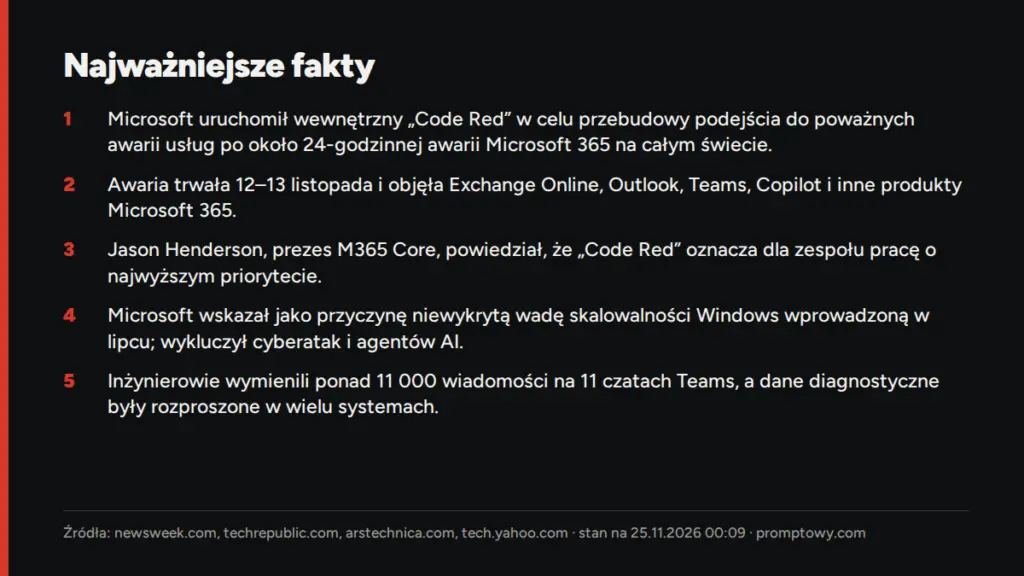
Microsoft has declared an internal "Code Red" after the November 12-13 outage that cut customers around the world off from Exchange Online, Outlook, Teams, Copilot and other Microsoft 365 services for nearly a full day. Microsoft Code Red is a mode in which improving service resilience becomes the team's top-priority work. The culprit was not a cyberattack but a flaw in the code that had been sitting in the system since July.
- The November 12-13 outage hit Exchange Online, Outlook, Teams, Copilot and other Microsoft 365 services, and was caused by a scalability flaw introduced in July, not a cyberattack.
- Code Red consists of five workstreams, and only three have been disclosed: load shedding, geographic partitioning of traffic and faster recovery.
- Microsoft wants to resolve global incidents within an hour but has given no date, and the contract promises 99.9% availability, or about 44 minutes of downtime a month.
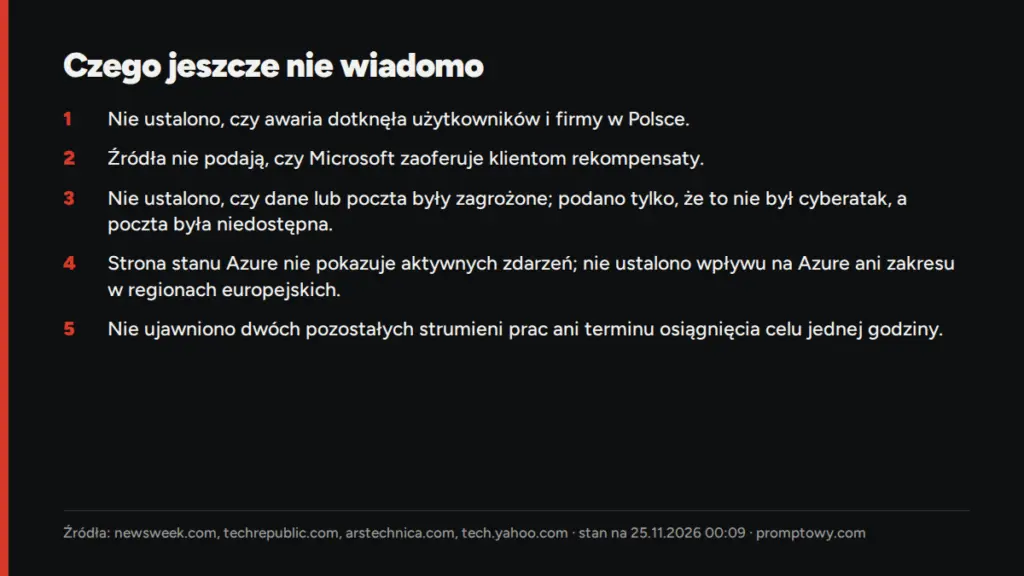
- No source says whether customers will receive compensation or how the outage broke down by country.
From now on, the company wants to resolve global incidents within an hour. It has not said when it expects to get there, and its own statements suggest it is far from that today. So I am more interested in what stands behind the slogan than in the slogan itself.
What Microsoft Code Red means for engineers
Jason Henderson, president of M365 Core, put it briefly: "Code Red" means this is the top-priority work for his team. Expert Anish Agarwal, quoted by Newsweek, explains it more broadly: projects unrelated to the goal are frozen and all available teams go to one task. That is his interpretation, though, not an official Microsoft description.
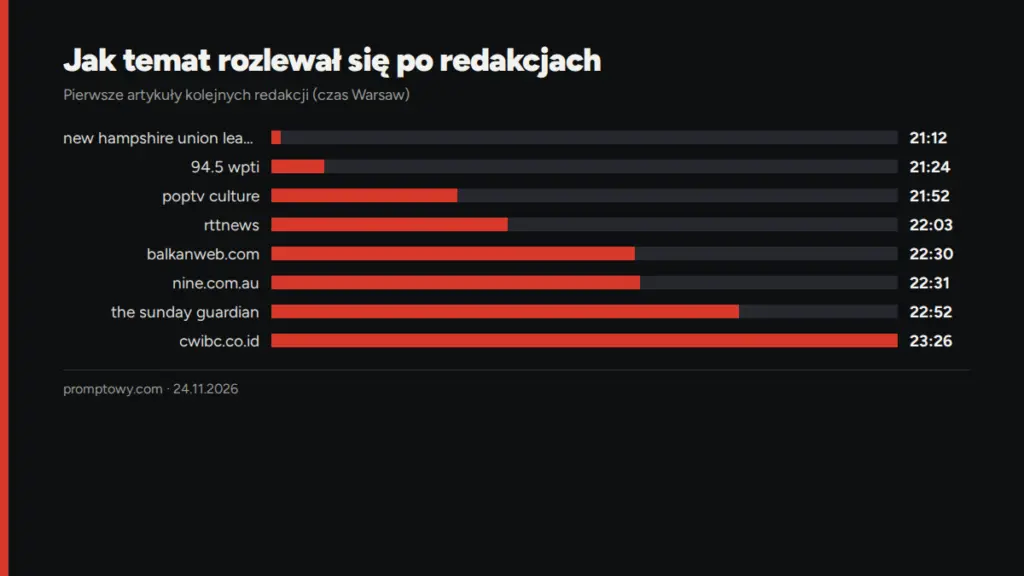
The name can be confusing, because in 2001 "Code Red" was a worm that exploited a hole in the IIS server. The current initiative has nothing to do with it. I described the first reports about it in an article on what the company confirmed and what comes from a leak.
According to Reuters, Henderson now holds daily meetings with the engineering leadership of the Substrate team, and senior leadership reviews progress once a week. This is the first tangible sign that the slogan has made it onto calendars.
What broke and why the fix took almost a day
Microsoft pointed to an undetected Windows scalability flaw introduced in July as the cause, and ruled out both a cyberattack and any involvement of AI agents. This is not about ordinary Windows installations on customers' computers and servers. The flaw affected the network gateways serving Exchange Online, as TechRepublic clarified.
| Date | What happened | Source |
|---|---|---|
| July | A scalability flaw enters the code and goes unnoticed for about four months | Newsweek, AOL |
| November 12-13 | Outage of Exchange Online, Outlook, Teams, Copilot and other Microsoft 365 services | Newsweek |
| November 20 | Microsoft publishes its post-incident report | Ars Technica |
The mechanism is described in the November 20 report, discussed by Ars Technica. Gateway processes blocked one another's access to the same resources, a bit like customers lining up at the only open checkout. Switching Teams traffic added load, and maintenance work was keeping almost 14% of gateway server capacity offline at that moment.
The fault itself is one thing, and the chaos of fixing it is another. Engineers exchanged more than 11,000 messages across 11 Teams chats while diagnostic data was scattered across many systems. Amanda Silver of Microsoft called it working in the "fog of war."
https://www.youtube.com/watch?v=fxcVEYCBWFY
Charles Lamanna added that the faulty component had collected roughly ten years of "acceptable failures," meaning minor faults that each fell within the norm on their own. Henderson called this outage the most severe for customers in the history of Exchange Online. He said that never before had so many customers been without email for so long.
"Never before had so many customers been without email for so long" - Jason Henderson, president of M365 Core
The sources disagree on how long the outage lasted. Media write about 24 hours, while Microsoft says the active impact on customers ended slightly before the 24-hour mark, followed by monitoring and working off the backlog of mail. Not every customer was cut off the whole time, because Teams, SharePoint and OneDrive partially recovered earlier than Exchange Online.
According to the report, the outage affected most of Microsoft's users, who number between 420 and 450 million. Government administrations in the US, Australia and Japan were hit, firms trading on the markets reported delays, and airlines had disrupted communications.
Anderson Economic Group estimates the loss to the global economy at about $7 billion in lost productivity. That is one analytics firm's estimate, not a bill issued by Microsoft.
How much is a one-hour promise worth
Silver presented five workstreams, of which I know three. The first is load shedding, meaning controlled dropping of part of the load so that an overloaded system does not go down entirely. The second is geographic partitioning of traffic, so that trouble in one region does not spill over to the rest of the world, and the third is faster recovery mechanisms. Reuters did not disclose the other two.
On top of that comes an announcement that Microsoft will deploy its own AI agents to help engineers read system health data faster. After 11,000 chat messages, that idea makes sense. I wrote about another attempt to entrust decisions to models in my piece on Microsoft-Decision-1.
The most prominent goal is resolving global incidents within an hour, but it is an announcement without a date. TechRepublic rightly notes that an hour is a target, not a service guarantee.
The distance to that goal is shown by a number given by Henderson himself. As Yahoo Tech reports, in another recent incident an urgent production fix needed five to six days to reach global rollout. Henderson admitted: "we're not there yet." So a company that takes almost a week to distribute a patch is promising a fix within an hour.
The second reference point is in the contract. Microsoft promises business customers 99.9% availability of Microsoft 365, which according to AOL allows about 44 minutes of downtime a month. The November outage exceeded that limit many times over.
Satya Nadella apologized publicly. At The New York Times' Dealbook Summit he said he was "extremely sorry" to those affected. The gesture is fine, but an apology is not a recovery mechanism. Expert Gerchow summed it up in Newsweek this way: declaring "Code Red" is the easy part, and keeping focus after months is harder.
Azure, data and compensation: what I could not confirm
I could not determine how the outage affected users and companies in individual countries. The sources speak of a worldwide reach and of "most" users, but none of them breaks this down by country or European region.
On November 25, 2026, I opened the Azure status page to check whether the problem also covered Azure and how it looked in Europe. The page shows no active events. I did not confirm any impact of the November 12-13 outage on Azure, and the reports concern Microsoft 365 services.
On data security, two things are known: Microsoft ruled out a cyberattack, and email was unavailable. Whether data or messages were put at risk in any way, the sources do not settle. None of them says anything about compensation for customers.
What next
For now there is a candid diagnosis, there are daily meetings and three known directions of work, but I found no new customer guarantees tied to "Code Red." Until the one-hour goal has a deadline and makes it into the SLA, "Code Red" is Microsoft's internal matter.
I will be watching for three things: disclosure of the two missing workstreams, a date for the one-hour goal, and any statement about compensation. Microsoft 365 administrators should look at their own contract now and check what the 99.9% availability clause gives them after a month like this.
Sources
- Historic Microsoft Outage Prompts 'Code Red' Outage Response - Newsweek (newsweek.com)
- Microsoft 365 ‘Code Red’ Targets Faster Outage Recovery (techrepublic.com)
- Microsoft's historic cloud outage exposed an engineering “fog of war” - Ars Technica (arstechnica.com)
- Microsoft declares 'Code Red' after historic service outage (tech.yahoo.com)
- Microsoft declares internal ‘Code Red’ after historic 24-hour outage - Reuters (tech.yahoo.com)
- Microsoft issues 'code red' following worst email outage (jang.com.pk)
- Microsoft declares a code red in the middle of a 'Patchpocalypse' - AOL (aol.com)
- Microsoft Declares ‘Code Red’ After Massive 365 Outage (thedailybeast.com)
Frequently asked questions
What is Code Red at Microsoft?
It is an internal mode of work declared after the November 12-13, 2026 Microsoft 365 outage. According to Jason Henderson, president of M365 Core, it means top-priority work for his team. It covers five workstreams, including load shedding, geographic partitioning of traffic and faster recovery. It has nothing to do with the Code Red worm from 2001.
How long did the Microsoft 365 outage last and what stopped working?
The outage ran November 12-13. Microsoft says the active impact on customers ended slightly before the 24-hour mark, after which the mail backlog was worked off. Exchange Online, Outlook, Teams, Copilot and other Microsoft 365 services were affected. Teams, SharePoint and OneDrive partially recovered earlier than email.
Will customers get compensation for the outage?
I could not determine that. The sources describe the outage as global, affecting most of Microsoft's 420-450 million users, but none of them breaks it down by country or says whether Microsoft will offer compensation. What is known is that the business contract promises 99.9% availability, which allows about 44 minutes of downtime per month.