December Solstice 2026: When Is the Shortest Day in the U.S.?
The December solstice falls on Monday, December 21 at 3:50 p.m. EST. Here’s why the earliest sunset can come before the shortest day.
Contents 5
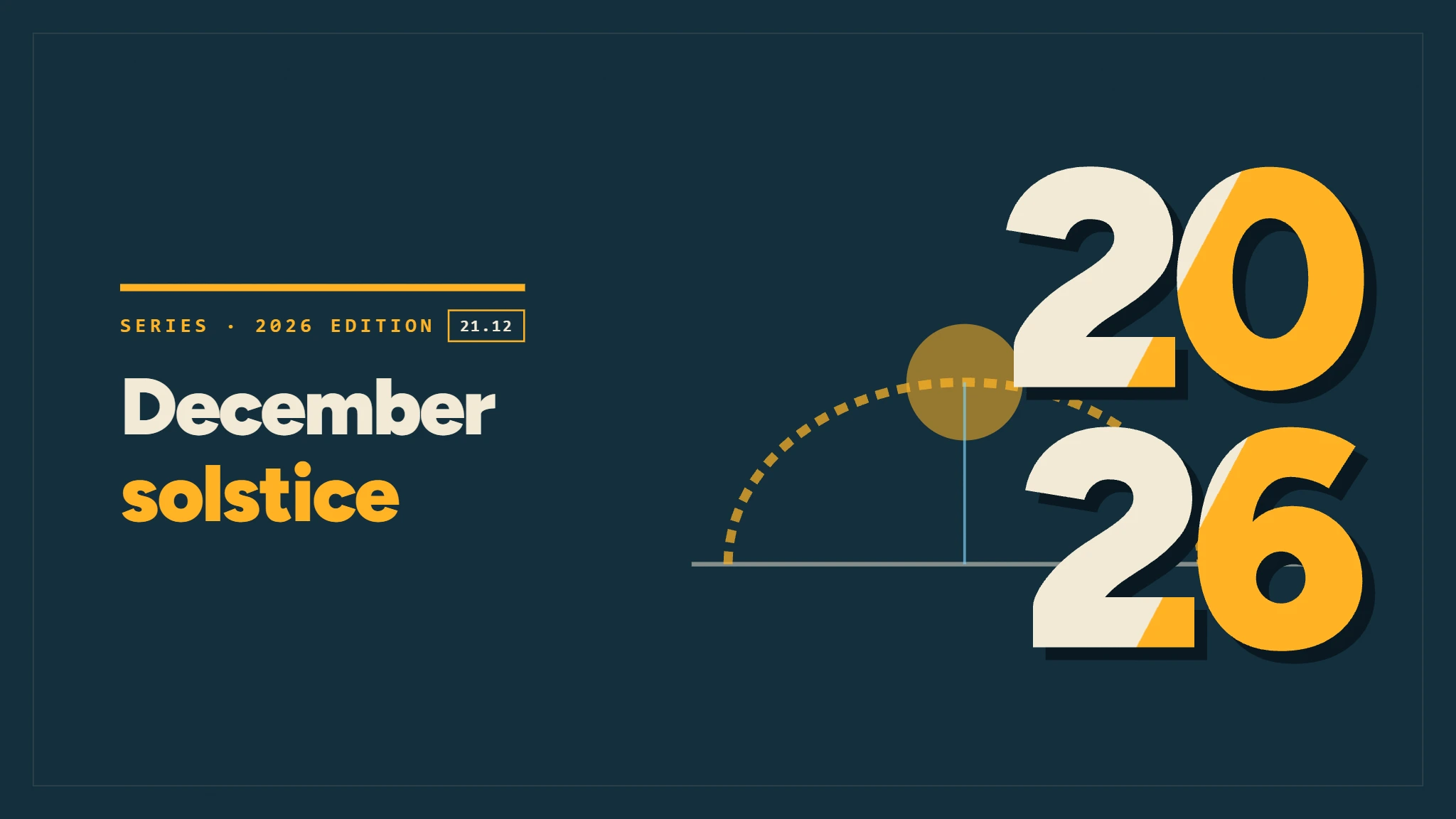
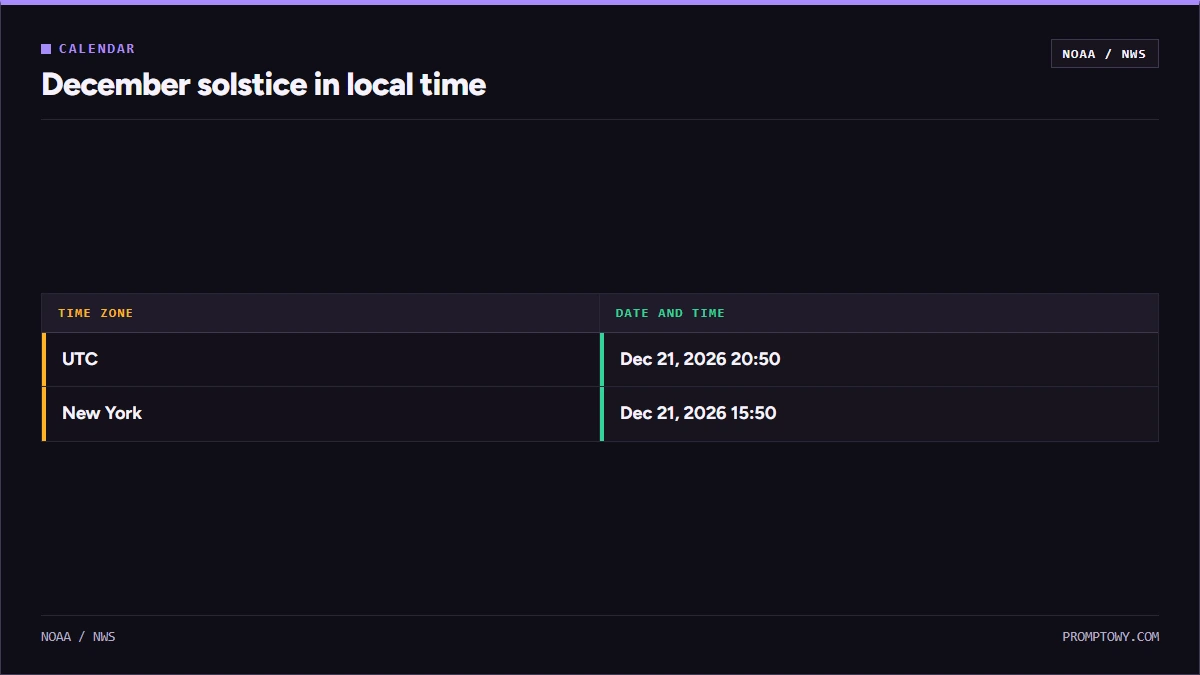
The December solstice is Monday, December 21, 2026, at 3:50 p.m. Eastern Standard Time. That’s 2:50 p.m. Central Standard Time and 20:50 Universal Time. It marks the start of astronomical winter and the shortest day of the year in the Northern Hemisphere. For anyone hoping for a brighter evening commute, the earliest sunset can already be behind you by then.
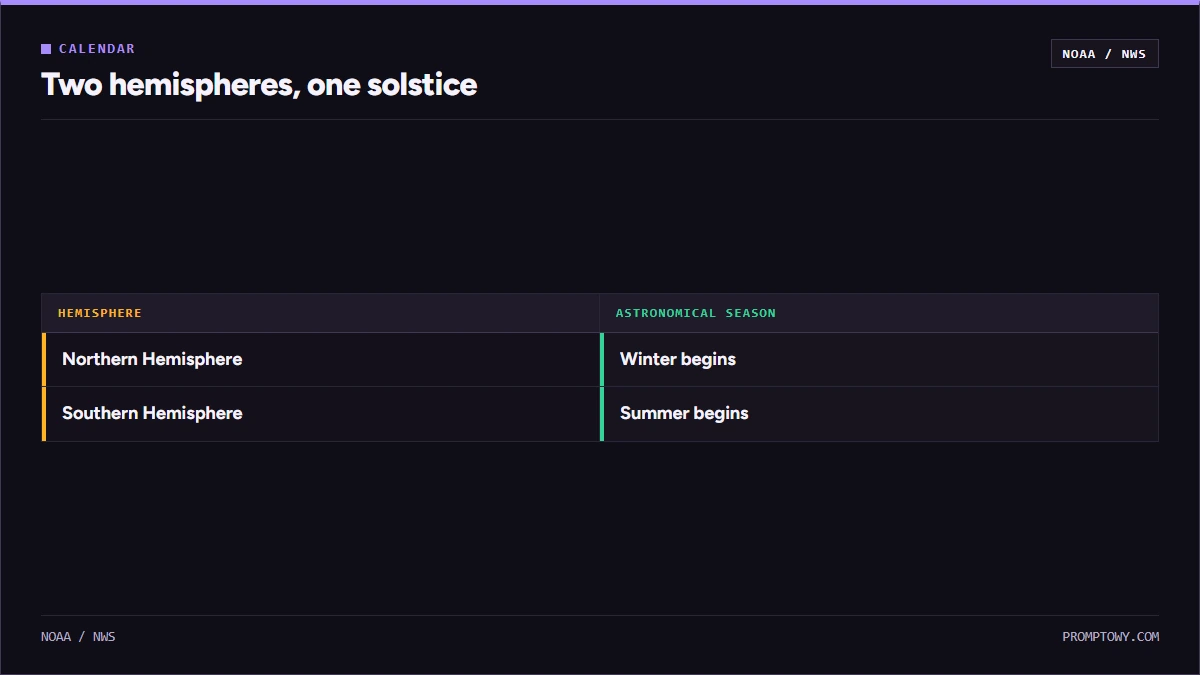
- Astronomical winter begins in the Northern Hemisphere and summer in the Southern Hemisphere.
- The December solstice falls on Monday, December 21 at 3:50 p.m. EST. Here’s why the earliest sunset can come before the shortest day.
What time does astronomical winter begin?
I checked the National Weather Service’s astronomical seasons table for the Quad Cities. It puts the 2026 solstice at 2:50 p.m. CST on December 21, the same instant that clocks in New York read 3:50 p.m. EST. In Tokyo, it will already be 5:50 a.m. on December 22. The calendar date can also vary from year to year. For the Southern Hemisphere, the December solstice marks the start of astronomical summer.
At the solstice, the Sun reaches its farthest south position in its apparent annual path. Across the Northern Hemisphere, its daily path stays low in the sky, with less time above the horizon. Your latitude affects how low that path is and how long daylight lasts. The solstice time is shared worldwide, while sunrise and sunset belong to the place where you’re standing.
How can sunset get later while days are still getting shorter?
Picture the daylight hours as a window bounded by sunrise and sunset. Near the winter solstice, the window is still narrowing, but the whole window can also slide later on the clock. If sunrise moves later by more than sunset does, the gap between them shrinks even as the evening gets a little brighter at the same clock time.
One reason for that slide is the shift in solar noon, the time when the Sun reaches its highest point for the day. The tilt of Earth’s axis and its changing orbital speed make solar noon drift relative to the clock over the year. Around the December solstice, the length of daylight changes slowly enough for that drift to affect which dates have the earliest sunset and the latest sunrise. The Quad Cities forecast office illustrates the separation with approximate local dates around December 8 for the earliest sunset and January 5 for the latest sunrise.
How fast does daylight return after December 21?
There’s no single minutes-per-day figure for the United States. The gain depends on your latitude and on which dates you compare. Near the solstice it can be small enough for a sunrise or sunset table rounded to whole minutes to show the same time on successive days. To measure the gain, subtract sunrise from sunset for each date, then compare those daylight totals. To see whether you’ll have more light after work, compare sunset times alone.
Example: If you’re planning a walk along the riverfront in Davenport, Iowa, compare local sunsets in early and late December to see when your evening window starts opening up. For a before-work walk, compare the sunrise column through early January. You may see more light on one walk while the other still starts in the dark.
Sources
- The Seasons (Equinoxes and Solstices) Page
- NASA - SKYCAL - Sky Events Calendar
- Sunrise and Sunset Times Near the Solstices
Frequently asked questions
When is the December solstice in UTC?
December 21, 2026 at 20:50 UTC.
Which season begins in each hemisphere?
Astronomical winter begins in the Northern Hemisphere and summer in the Southern Hemisphere.